Monday, May 21, 2012

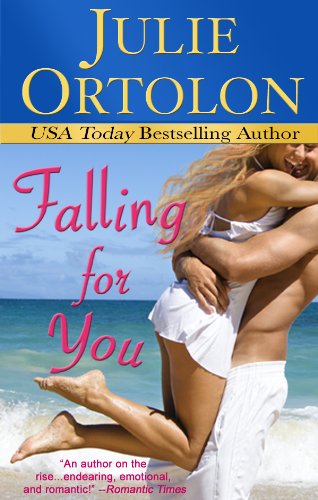
Falling for you


Ortolon, J. (2002).  Falling for you. New York: St. Martin's Press.

Annotation: Sexy but broke Aurora St. Clair enlists the help of blue-blooded banker Oliver Chancellor so she can open a bed and breakfast in the mysterious Galveston mansion.

Summary: Aurora "Rory" St. Clair and her siblings live with their aunt, who took them in when their mother died. Rory has an impulsive streak so when she sees a for sale sign being nailed in front of the home that belonged to the St. Clair's ancestors (and which is home to some scandalous history) she immediately decides she wants to buy it and make it into a bed and breakfast. Against his better judgement Oliver "Chance" Chancellor, local banker, decides to help her get a loan. He says it's so that he can try his hand at a new business, but it's also because he wants to spend more time with Rory. Will Chance leave his predetermined path as a banker at his dad's bank to follow his heart? Will Rory's dream of opening a B&B come true?

Review: This book surprised me. It's definitely firmly in the romance genre, but it was more than just that. Rory was a spunky and headstrong character and her siblings were well developed and likeable. I'm not sure that I entirely bought that Chance would be planning a loveless marriage to his childhood friend because that's what was expected of him, but then I'm not from a rich family with long traditions. There are some definite surprises in the plot, but they were believable and added richness to the story. I plan on reading the next two in this trilogy and I'm not a romance fan!

Series: Pearl Island trilogy
Possible recommendations: Nora Roberts

Rating: 3Q, 2P

Friday, May 18, 2012

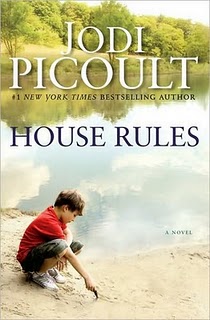
House Rules


Picoult, J. (2010). House Rules. New York: Atria.

Annotation: Eighteen year-old Jacob Hunt, an "Aspie" who is obsessed with forensics, is accused of murdering Jess Ogilvy, his social skills teacher.

Summary: Jess Ogilvy, a vivacious grad school student and social skills tutor, is found dead in the house she is watching. Jacob, an 18 year old with Asperger's disorder is one of her students. Jacob is obsessed with forensics and keeps a detailed notebook of crimes and their solutions. Jacob's fingerprints and backpack are found in the home and the notebook of crimes is found in the backpack with an unnamed crime scene that seems identical to that of Jess makes Jacob a suspect in her murder. After Jacob admits to moving her body he is arrested and charged with the crime. Because he is 18 his mother Emma is not allowed to be present during his interrogation and the detectives mistake common Asperger's symptoms like the inability to look them in the eye as a sign of guilt. As Emma fights to protect him from the police and the court system his fourteen year old brother Theo is neglected and becomes resentful. Eventually we find out that Jacob solved they mystery of Emma's death and that she wasn't murdered, but that she slipped and fell in the shower. Theo witnessed the accident and Jacob was aware of this because he saw Theo leave the house.

Review: I was interested in reading this because the main character is "on the spectrum" and I've worked with many autistic children through the years. I'm glad that Picoult is bringing these disorders to light, but I think that her approach was too heavy handed. Jacob has EVERY symptom of Asberger's and very severe cases of them, which isn't how Asperger's works. Once I got past that I enjoyed the characters in this book. I felt for Emma and especially Theo and could really see how having a family member with Asperger's would overshadow so many other aspects of family life and make a "normal" child's needs secondary. I'd recommend this to anyone looking for realistic fiction with a little something else thrown in.

Possible recommends: Other Picoult books, Ann Hood, Anna Quindlen, The Abortionist's Daughter by Elisabeth Hyde

Rating: 3Q, 4P

The Eyre Affair


Fforde, J. (2002). The Eyre affair. New York: Viking.


Annotation: In an alternate reality in 1985, where cloning and time travel are common, literary detective Thursday Next must enter Jane Eyre to rescue Jane from literary homicide.

Summary: I'm really sorry. I know this was one of the book discussion group selections. The farthest I got in my three attempts to get into this book was to chapter 5 so I am unable to summarize it.

Review: I tried to get into this book. I REALLY tried since it was for a book discussion group. I absolutely hated it. I found myself confused the majority of the time and really not enjoying myself. I put it down and restarted the book three times. Did I mention I hated this book? I can't think of one person I'd recommend this to.

Possible recommendations: Other books by Jasper Fforde.

Rating: 1Q, 1P


Sunday, May 13, 2012

The Lovely Bones


Sebold, A. (2002). The Lovely Bones. New York: Little, Brown.

Annotation: Fourteen year old Susy Salmon is abducted, raped, murdered and dismembered by a local man after taking a short cut home.

Summary: On a cold winter day, fourteen year old Susy Salmon decides to take a shortcut home from school by cutting through a neighbor's field. As she passes through
36-year old George Harvey who is a dollhouse maker asks her to take a look at the underground den he's dug for the local kids to hang out where he then rapes and kills her. Susy flies away to her own personal heaven and watches as her family struggles to heal and gain closure from her death.

Review: I went into this book expecting a tough read. I mean, it's about the rape and murder of a child. Once the story turned to the relationships of the people affected by Susy's death I was involved and committed to it, but when it took a weird turn at the end with Susy "occupying" her childhood friend's body so that she could experience sexual relations I was done. I found that to be so far out of the realm of what I consider possible that I couldn't shake my disappointment in the book.

Possible recommendations: The sweet hereafter by Russell Banks, Durable Goods by Elizabeth Berg, Peace like a river by Leif Enger.

Rating: 2Q, 4P

Saturday, May 12, 2012

Handmaid's Tale


Atwood, M.(2006). The Handmaid's tale. New York: Everyman's Library.

Annotation: Religious fundamentals rule what was once the United States and fertile women are given to powerful men to serve as Handmaids.

Summary: Told from the point of view of Offred, A Handsmaid's Tale is set in a time when a radical religious group called the Sons of Jacob have killed the President of the United States and overthrown the government. All banking is done electronically and through the simple act of taking control of women's bank accounts they effectively wipe out women's rights. Eventually families are split up and are divided based on their abilities and are in service to the ruling class. Women who refuse to be in service are called unwomen and are shipped off to colonies where they perform manual. Offred is a concubine, or Handsmaid, to Fred whose wife Serena Joy is infertile based on a passage in the Old Testament. While Fred's only contact is supposed to be sexual intercourse during "the Ceremony" with Serena Joy present, Fred begins an illicit relationship with Offred, giving her contraband like lotion and reading materials as well as taking her to a government run brothel. Serena Joy also enters into an illicit relationship with Offred, convincing her to begin sexual relations with Nick, Fred driver in an attempt to become pregnant using photos of Offred's daughter and the knowledge that Offred will be sent to a colony if she doesn't become pregnant soon. The agreement between Offred and Serena Joy ends when Serena Joy discovers evidence that Offred and Fred have been meeting secretly and Offred is taken away by the secret police. In the last chapter we learn that government of Gilead was eventually overthrown and that the story was actaully a series of tapes that were found in the future.

Review: This was a confusing story, but a compelling one. It is entirely possible to imagine something like this happening, with the growth of intolerant religious right groups and with our continued reliance on debit cards rather than actual cash. Offred's passiveness really bothered me, but it makes sense since the Handmaids were extensively brainwashed. I'd recommend this book to anyone who is interested in religious freedom or feminism.

Possible recommendations: 1984 by George Orwell, Fahrenheit 451 by Ray Bradbury.

Rating:3Q, 3P


Helen of Pasadena


Dolan, L. (2010). Helen of Pasadena. New York: Prospect Park.


Annotation: Helen's privileged lifestyle abruptly ends when her husband crashes into a Rose Parade float while texting his girlfriend and dies.

Summary: Helen Fairchild, raised by hippy parents in Oregon, was all to happy to trade that existence for one of wealth and stature when she married and moved to Pasadena. Her world is turned upside down when her husband announces he is leaving her for a TV newscaster and then manages to get himself killed by a Rose Parade float. Forced to keep her husband's secrets- his cheating ways and their true financial status to name a few- to protect the Fairchild name while simultaneously dealing with them is no small task, but with the help of good friends and a supportive mom Helen rises to the top, finding herself, love and the true value of life along the way.

Review: This was a great read. Helen is a strong main character, navigating her way through a tough time with grace. The book is funny and the details of the life of Pasadena's elite ring true. I loved the descriptions of the Huntington and Helen's experiences there with the head research librarian were fun to read (what a great place to work!). I'd easily recommend this to others.

Rating: 4P, 4Q

Invisible Life


Harris, E.L. (1991). Invisible Life. Anchor Books: New York.

Annotation: Raymond, a bisexual African American lawyer recounts his relationships with men, women and his family as he mourns his first lover's wife's death from AIDS.

Summary: Raymond Tyler, Jr., from Birmingham, Alabama has had one serious girlfriend since high school. In his senior year of college he meets Kelvin, who propositions Raymond, awakening in him feelings he's never acknowledged. As Ray and Kelvin spend more time together Ray begins to develop feelings for Kelvin and starts to question his relationship with Selma, who he'd always assumed he'd marry. To escape the situation he takes a job in New York where he immerses himself in the gay lifestyle, all while remaining closeted at work and for the most part with his family. Then he meets Nicole, a beautiful dancer and the best friend of Kelvin's fiance. Nicole is deeply Christian and wants a commitment from Raymond, but unbeknownst to Nicole, Ray is also involved in a hidden relationship with a married man. Ray knows he has some choices to make. He loves Nicole, but can he commit to a lifetime with her and never be with another man?

Review: This was a very touching novel. Harris does a great job of conveying the struggles of an African American man who very clearly identifies as both gay and straight. He clearly paints a picture of the homophobia often present in the African American community, where gay men are seen as traitors to the race. I would recommend this book to anyone looking for books that explore what it means to be gay, straight or bisexual.

Possible recommendations: Other books by this author, Eric Jerome Dickey, Terry McMillan

Rating: 3Q, 2P

Guns of the Timberlands


L'Amour, L. (1955). Guns of the Timberlands. New York: Bantam Books.

Annotation: Clay Bell must stop Easterner Jud Devitt from clearing the timber at Deep Creek Range, where Clay grazes his cattle.

Summary: Clay Bell's done a bit of everything. He's been in the army, fought the Indians and eventually drifted his way in to Arizona where he built the B-Bar ranch. Deep Creek Range is one of his preferred grazing spots, with its lush grass that grows under the majestic trees. When easterner Jud Devitt, who's rich, ruthless and accustomed to getting his way rolls into town demanding that Clay remove his cattle from this government property so that he can clear the timber to sell to the Mexican Central Railroad Clay is not about to comply. He's worked too hard building his business to see the Range destroyed for its timber. Jud sees Clay as an obstacle to what he wants and he's determined to remove the obstacle, but Jud doesn't understand what it is to be a man who is committed to what's right. When the battle between Jud and his lumberjacks and Clay and his cowhands begins it get fierce and fast. Guns blaze and fists fly leading the reader to a satisfying conclusion.

Review: I really enjoyed this book! It was well written and packed with action. Clay was a likable character who took the time to think things through and didn't just rush headlong into things like Jud did. I was not at all surprised at the ending, but in a book like this, it's the adventure not the ending that you are in for. My only complaint is that L'Amour shifts between calling his characters first and last name so often that I sometimes thought I was reading about two separate characters and would have to go back and re-read.

Possible recommends: Other L'Amour titles, Zane Grey. Elmer Kelton

Rating: 4Q, 5P

The Abortionist's Daughter


Hyde, E. (2006). The Abortionist's Daughter. New York: Alfred A. Knopf.

Annotation: Outspoken abortionist Diana Duprey is found dead in her pool and the police must catch her killer.

Summary: Diana Duprey has had a rough day. First there was the argument with her daughter, then the one with Stephen O'Connell, the town's pro-life activist and finally the blow up with her husband Frank. Frank was incensed that Diana didn't really seem concerned about the nude, underage photos he found online of Megan through his work at the DAs office and leaves the house. When he returns he finds her dead in the pool with bruised arms and a bump on her head. It's now up to the police to find out who killed Diana and why.

Review: I wanted to like this book and for the most part I did, until around half way through when the young detective working on the case lets Megan push her way into his house and then ends up spending the night. And if that wasn't enough, they end up sleeping together. I found it wholly unbelievable that a cop with a previous internal affairs background would do this. And then there's the issue of the killer- it was "hit me over the head" obvious from the beginning so I kept thinking, "Would you share what the other characters are hiding so that we can see it's not them and you can arrest this guy already." Still, her actual writing style is one I enjoyed and this book got a lot of buzz so I'm mostly glad I read it.

Possible recommendations: Jodi Picoult,
Chris Bohjalian, Anita Shreve

Rating: 2Q, 4P

Who Do I Talk To?


Jackson, N. (2009). Who do I talk to? Thomas Nelson: New York.


Annotation: When Gabby Fairbanks finds that her husband has changed the locks to their penthouse she realizes she needs one of those "God things" she's seen happen for other Christians.

Summary: Gabby is a wealthy wife and mother who suddenly finds that her husband has changed the locks and taken their kids to stay with his parents. He's angry because she's taken a job at a homeless shelter as its activities director and because her mother has temporarily moved in with them after the death of Gabby's father. New to Chicago, Gabby finds she has no where to go but to the homeless shelter where she just the day before resigned from her position. Life at the shelter is tough, but she finds that between the friends she has made there and their faith in God, she just might find that "God thing" she's witnessed in other Christians.

Review: I'll admit that I have never read Christian fiction before. I was pleasantly surprised with this book. Gabby is a likable character who is doing the best she can to survive a previously unthinkable situation. Presenting Gabby as a newcomer to the area made it believable that she would have no support system outside of the shelter. The homeless women in the shelter seem realistic if a little soft for the tough streets of Chicago. I think that Christian women seeking a novel where a woman is able to turn to God to overcome seemingly insurmountable obstacles will enjoy this.

Series: Yada Yada Prayer Group

Possible Recommendations: Other books in this series, Harry Bentley's Second Chance by Dave Jackson, Cape Refuge by Terri Blackstock, The Telling by Beverly Lewis

Rating: 3Q, 2P

World War Z


Brooks, M. (2006). World War Z. New York: Crown.

Annotation: Max Brooks, a UN Postwar Commission Agent shares first person accounts from people who lived through the ten-year long Zombie Wars.

Summary: This book is the compilation of first person accounts of life during and after the Zombie Wars or "World War Z." It was compiled by Max Brooks, a UN Postwar Commission agent, who did this because the official UN report chose only to focus on facts and figures and not on the lives of the people who survived the war. Through these accounts we learn that although it is still unknown how the first zombie was created, the first victim was a young boy in China. We also learn that while the War is officially considered over, there are still millions of zombies roaming the earth and the human population has been decimated in most areas and completely wiped out in others. World power has changed hands as well and Cuba- now a democracy- is both the financial and political leader.

Review:This was the first zombie novel I ever read and I thoroughly enjoyed it. Prior to reading this I thought zombie fiction would be all about the gore and more suited to teen boys that like video games. This book is definitely about zombie attacks, but Brooks clearly used this novel as a vehicle for social commentary. In my opinion, it was so well written that I felt like I was reading a true account of the actual effects of a war.

Possible recommendations: Zombie Survival Guide by Brooks, Zombiestan by Mainak Dhar

Rating:4Q, 2P

On a Pale Horse


Anthony, P (1983). On a pale horse. New York: Ballentine.

Annotation: Zane shoots Death instead of killing himself he finds that he now must take on the role of Death himself.

Summary: Zane is a depressed and broke photographer who decides that he may as well end his life. But just as he's about to pull the trigger he turns the gun on Death and kills him. As Death, he must weigh the amount of sin on souls that are close to being equal parts god and bad and then send it to Heaven, Hell or Purgatory. When he goes to collect the soul of a powerful magician he finds that the man had manipulated fate so that Zane would become Death because he wants him to protect his daughter Luna from Satan. He believes she's in danger because of a prophecy which says that she will thwart Satan plans. Satan in turn orchestrates Luna's death and she is slated to head to Hell because she has a large amount of sin from practicing black magic and from taking some of her father's sin so that Death would have to collect her soul. However, she performs a good deed right before her death putting her in balance and requiring Death to collect her soul. When he refuses he finds that no souls can go to Heaven or Hell, but are instead stuck alive. Satan's manipulation of events to cause Luna's death is eventually revealed and he must restore life to her allowing all of the trapped souls to die.

Review: I loved the premise of this books and couldn't put the book down. The writing is not great, but the story line is so clever that I kept turning the pages. I'd recommend this to anyone who is looking for a humorous look at what happens when we die. Someone who has very strongly held Judeo-Christian religious beliefs might find this too much at odds with their beliefs to enjoy it.


Series: The Incarnations of Immortality
Possible recommendations: The rest of the series, Neil Gaiman, Terry Pratchett

Rating: 2Q, 4P